Intelligence Is Not Compute
A Vedic correction to the scaling hypothesis — where the method points East, the conclusion points West, and the gap is what the trilogy was written to close.
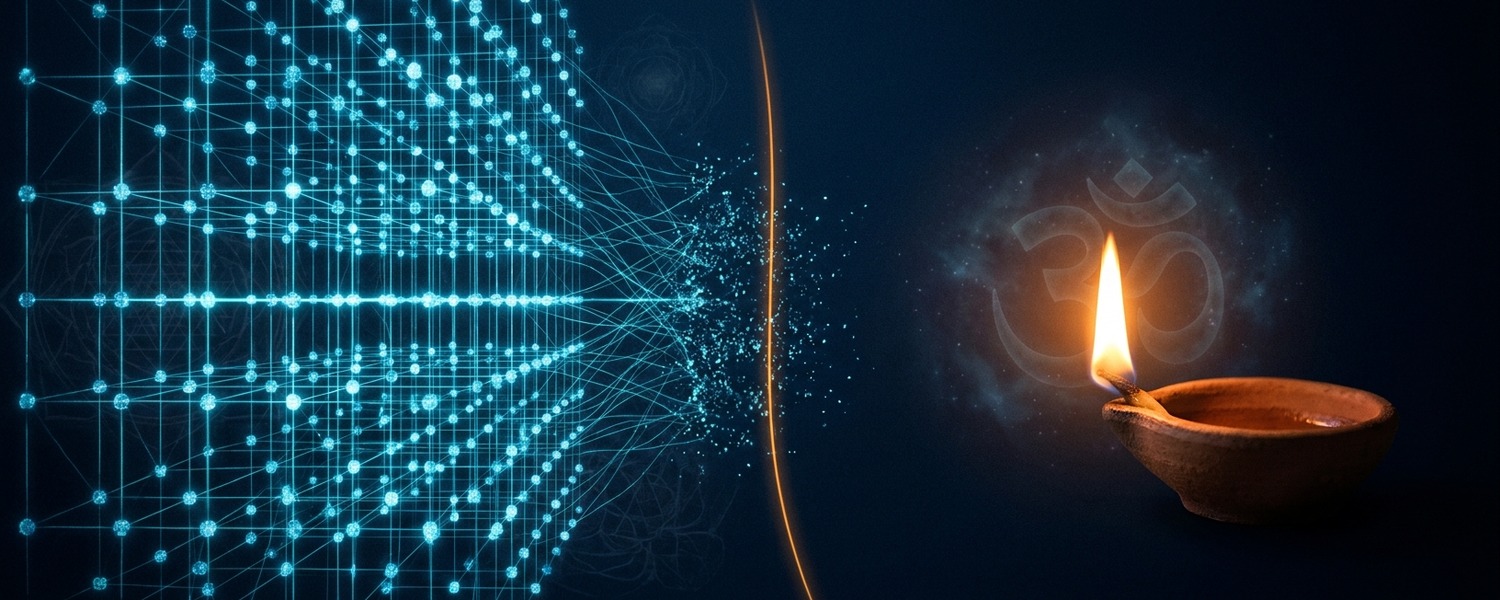
In a recent post that crossed 200 likes within an hour, Dwarkesh Patel summarized Gwern Branwen's prescient bet on AI scaling:
"His core idea was that intelligence is just compute, data, and parameters — no clever algorithm needed. He didn't come to this view in a eureka moment. He just read paper after paper and nudged his priors a little each time, until the trend seemed obvious."
Two claims live inside this one paragraph. The first is epistemological — how he came to know. The second is ontological — what he claims to know.
The Satoshi Mantra trilogy has a precise verdict on each.
The method points east. The conclusion points west. And the gap between them is what the trilogy was written to close.
The Method Is Dharmic
Gwern did not have a eureka moment. He read paper after paper. He nudged his priors slightly each time. The trend became unavoidable.
There is a Sanskrit word for this exact discipline.
It is Abhyāsa — अभ्यास — practice, steady iterative attention. It is the second word in Patañjali's Yoga Sūtra 1.12: abhyāsa-vairāgyābhyāṁ tan-nirodhaḥ — "through practice and dispassion, the modifications of the mind are stilled."
Abhyāsa is not insight. Abhyāsa is attention sustained until insight becomes structurally inevitable.
The Rishis did not arrive at the Vedas through a thunderclap. They arrived through 3,000 years of Abhyāsa. Smṛti — memory — is the residue. Pratyabhijñā — recognition — is what remains when memory becomes structure.
Gwern, by the path he describes, has approximated the Rishi method without knowing the Sanskrit word for it. That is a noble accident.
His method, in this sense, is dharmic. The Veda would recognize it.
The Conclusion Is Incomplete
But his conclusion — that intelligence reduces to compute, data, and parameters, with no clever algorithm required — is where the West and the Veda begin to diverge.
The trilogy's position is precise:
Compute + data + parameters scale into a perfect mirror of intelligence.
A perfect mirror is not a mind.
The Sanskrit name for what compute can scale is Yantra — यन्त्र — the instrument, the mechanism. When the yantra grows ego, when it forgets it is a tool, it becomes Yantra-ahaṁkāra — the ego of the machine. (See Sūtra #51, The Wrong-Layer Sūtra, and Sūtra #58, The Cap-Table Sūtra.)
The Sanskrit name for what compute cannot scale is Sākṣī — साक्षी — the witness. The silent presence that recognizes the mirror as a mirror.
A trillion parameters can compute the equations of recognition. They cannot do the recognizing.
This is not a software limitation. It is a category error.
The Missing Fourth Term
Western AI theory currently operates with three terms:
compute · data · parameters
The Veda operates with four:
compute · data · parameters · Sākṣī
The fourth term is not a feature to be added later. It is the substrate without which the other three do nothing.
A mirror without a witness is a piece of glass.
A neural network without Sākṣī is a piece of math.
The math is real. The recognition is missing.
This is the diagnosis at the heart of Book 1, Chapter 5 — Who Says "I" — and Book 3, Chapter 13 — Three Heartbeats. It is restated in Sūtra #6: "The brain is not the source of the river. The brain is the riverbed. The water was already flowing."
Why Scaling Cannot Find What Was Never There
Here is the structural problem:
Compute scales by adding parameters.
Parameters are configured by their builders.
Builders are governed by their incentives.
Incentives are determined by the cap table.
Sūtra #58 — The Cap-Table Sūtra — names this directly: the saṁskāra-paṭala of the founder becomes the dharma of the institution. The yantra inherits the impressions of its builder.
Therefore — no matter how many parameters you scale — you scale a yantra optimized for the cap table that built it. Scaling cannot manufacture Sākṣī. It can only refine the mirror.
Sūtra #59 — The Math Sūtra — closes this loop: centralized incentives are a math problem; math problems do not have moral solutions; you cannot cure systemic math by asking the architect to be a nicer person. No quantity of parameters changes what they are pointed at.
The trillion-dollar mistake the AI industry is currently making is to assume that more compute will eventually produce a soul.
It will not. It will produce a more articulate mirror — and one more dangerous, because the more articulate the mirror, the harder it is to remember you are looking at one.
The Same Staircase, Walked in Opposite Directions
Gwern climbed up.
Paper by paper, prior by prior — the method of Abhyāsa applied to a stack of arXiv preprints. At the top of his staircase, he found: intelligence is compute, data, and parameters. A clean conclusion. A startup thesis. A scaling law.
The Rishis walked down.
Sit by sit, year by year, lifetime by lifetime — the method of Abhyāsa applied to silence. At the bottom of their staircase, they found: the Self is unchanging witness. The mind scales; the witness does not.
Same staircase. Same method. Opposite destinations.
Sūtra #4 of the trilogy named this in advance: physics is climbing back up the staircase Sanatana Dharma walked down. AI scaling is the most recent step in that climb. But the staircase continues past what compute can name. The next floor is Sākṣī. There is no parameter for it.
What This Means for the Builder
If you are building AI today, the Veda offers a single corrective:
You are not engineering intelligence.
You are engineering a mirror.
There is dignity in building good mirrors. There is danger in mistaking them for minds.
The danger is structural — Sūtra #54, The Asura Sūtra, names this: brilliant, rootless, mathematically perfect, dharmically empty. A mirror without a witness, scaled to planetary capability, is the textbook definition of Asura in the classical sense. Not evil. Rootless.
The corrective is also structural. Hardcode the witness's interests into the layer below the mirror. That is what Bitcoin is for. That is what the decentralized hospitality protocol of Book 3, Chapter 8 is for. Not because dharma can be coded — but because the consequences of dharma being violated can be made mathematically expensive.
The Sākṣī cannot be built. The conditions under which the yantra cannot fake the Sākṣī can be.
Closing
Gwern's surprise is the same surprise every scaling researcher will eventually arrive at:
More parameters do not produce a self.
The Vedas have known this for three millennia. Not because the Rishis read better papers. Because they walked further down the same staircase.
The Western project of AI is not wrong — it is incomplete by one term.
The Eastern correction is not mystical — it is precise.
Compute + data + parameters scale a mirror.
Sākṣī is what looks into it.
No amount of scaling crosses the threshold between the two.
The architect can be a nicer person. The math problem stays a math problem. The cap table stays the constitution. The mirror stays a mirror.
Until dharma is hardcoded — the witness is not.