The God No Parent
Would Recognize
Why eternal hell is structurally incoherent — a Vedic correction to the Abrahamic punishment-and-confession theology.
Imagine a human parent with two children.
One follows the household rules. Studies, helps, returns calls. Builds a life the parent can recognize.
The other rejects every correction. Walks into addiction. Walks into ruined relationships. Walks into the long isolation that follows lying to everyone who loved you. The parent watches the slow ruin from the kitchen window for years.
At no point does that parent torture the rebellious child for eternity.
The parent disciplines. Withholds money. Refuses to enable the harmful path. The parent grieves. Some parents go to therapy. Some never recover. But no parent — not even the most punitive, not even the most religious — locks their child in a basement and burns him for the rest of forever.
If they did, we would call them a monster. We would jail them. We would forbid them from ever holding a child again.
Now hold this exact scenario up against the Abrahamic God.
1. The Argument in One Move
If a flawed human parent will not eternally torture their disobedient child, how can a perfect Creator send any of their children to eternal hell?
That is the entire argument. It is not a debate. It is a single observation, and once seen it cannot be unseen.
The doctrine of eternal damnation holds the Christian God to a lower moral standard than a flawed human parent. Worse than the worst parent we would ever permit on earth. The argument is structural. It is not anti-Christian; it is anti-incoherent. A Creator more cruel than His own creatures cannot be the source of those creatures. The vessel cannot be more refined than the potter.
A Creator more cruel than His creatures
cannot be the source of those creatures.
This is why the Vedic tradition never developed a doctrine of eternal hell. Not because the rishis were soft on consequence — they invented karma, which is more rigorous than any pastor's threat. They never developed it because they could see what the parent analogy makes obvious: an actual creator does not destroy creation.
2. What the Rebellious Child Actually Experiences
Return to the original analogy.
The rebellious child's life, by the third decade, looks like hell. Addiction. Lost relationships. The shame loop. The morning-after stomach. The mirror that asks the same question every day.
This is hell. It is real. It is felt. It is, in every sense, punishment.
But it is not the parent's punishment. It is the consequence the child built for himself, day by day, through ten thousand small choices that compounded. The parent only watched. The parent grieved. The parent kept the door open in case the child ever decided to come home.
This is the Vedic doctrine of karma-phala — the fruit of action belongs to the actor.
The Creator does not send anyone to hell. Karma does. The Self does.
Hell is not a destination administered by a deity. Hell is a state self-created by misaligned action — here, on earth, in this body, in this life. The same body can carry heaven on Tuesday and hell on Friday, depending on the karma planted Sunday through Wednesday.
Bhagavad Gītā 4.17:
gahanā karmaṇo gatiḥ
"Deep is the path of karma."
Karma is not a punisher. Karma is a mechanism. It does not have an opinion about you. It does not lose its temper. It does not need worship. It simply delivers — and what it delivers is what you sent.
3. The Second Defect: Confession
If the first half of the Christian doctrine breaks under the parent analogy, the second half breaks just as cleanly.
The Catholic Church teaches that sin can be forgiven by confessing to a priest. The Protestant tradition variously accepts forgiveness by personal acknowledgment to God. The structural claim in both is that karma can be erased by acknowledgment.
This is incoherent.
If you drink poison on Monday and tell a pastor on Tuesday that you regret drinking poison, the poison is still in your bloodstream on Wednesday. Acknowledgment does not metabolize what action created. Apology does not unwind addiction. Confession does not unfire a bullet.
A middleman cannot undo what action made.
Karma has no customer-service desk.
This was named by the Veda three thousand years before the Council of Trent codified the sacrament of confession. Muṇḍaka Upaniṣad 1.2.7:
plavā hyete adṛḍhā yajña-rūpāḥ
"These sacrifices are weak boats. They will not carry one across."
The rishis already knew that ritual atonement is a weak boat. Performing the sacrifice, reciting the formula, confessing to the priest — these are gestures. They do not change the karmic balance. Only re-aligned action upstream changes the balance.
You cannot ritual your way out of karma.
You cannot confess your way out of karma.
You cannot pay your way out of karma.
You can only act your way out — by realigning the cause and bearing the fruit of what was already sown.
This is harder than confession. But it is the only path that respects the mechanism.
4. Why the Abrahamic God Was Constructed This Way
It is worth asking: why did the Abrahamic tradition develop a punishing-parent God who tortures eternally and forgives via priesthood?
The answer is institutional, not theological.
A God who simply names karma cannot be administered by an intermediary. Karma does not require a temple bureaucracy. It does not require tithing. It does not require priests to validate forgiveness. Karma is — to use modern language — a permissionless protocol.
A God who threatens eternal hell, and offers forgiveness only through ritual confession through an authorized institution, requires the institution. The whole apparatus exists because the doctrine requires it.
The Vedic mechanism eliminates the apparatus. There is no priest you must visit. There is no church you must attend. There is no specific formula you must recite. There is only your action, your consequence, and your re-alignment. The Creator watches. The Self bears. The action accumulates.
The Abrahamic God was constructed, in part, because karma is too decentralized to support an institution.
5. The Father Who Truly Understands His Child
Return one last time to the original image. The parent. The two children. The window.
A parent who actually understands his child does not threaten him with hell. The parent knows that threatening a rebellious child with eternal torture is the kind of move only the worst kind of caregiver would make — and even then, the child usually escalates the rebellion in response. Threat does not transform. Fear does not align.
A parent who truly understands the child names karma. The parent says:
"If you continue down this path, here is where you will end up. Not because I will punish you. I love you too much for that. But because your actions will deliver you there. Be careful what you sow. I will keep the door open. I cannot keep the consequences off you."
This is exactly what the Bhagavad Gītā says. Krishna does not threaten Arjuna with hell. He explains how karma works and then says: "having heard what I have said, do as you wish." (Gītā 18.63 — yathecchasi tathā kuru.) The choice is preserved. The mechanism is named. The Creator does not coerce.
This is the God a parent recognizes. A parent understands a Creator who lets choice stand and names consequence honestly. A parent does not recognize a Creator who tortures one of His own children for eternity for choices made in the brief window of a confused human life.
The Christian God of eternal damnation is a God no actual parent would recognize. That is the entire diagnosis. The doctrine has been refuted by every loving parent who has ever lived. They simply did not have the Sanskrit.
6. What This Does Not Mean
This essay is not a defense of moral relativism. The Vedic position is actually more rigorous than the Abrahamic one, not less.
Eternal hell, if taken literally, has the strange property that any consequence — however severe — is the same as any other. A murderer and a petty thief, if both unforgiven, get the same eternity. The doctrine flattens proportion. It is moral physics with only one switch.
Karma is the opposite. Karma is graduated. Every action carries its precise weight. The murder accumulates differently than the lie. The kindness compounds differently than the cruelty. There is no flattening. There is no all-or-nothing salvation. There is the slow, exact reckoning of what you sent, returning as you sent it.
This is harder. It is also fairer.
And it does not require a deity to enforce it. It is the mechanism by which the universe — or the Self, depending on which layer of Vedanta you read — keeps its own books. The Creator only watches. The Sākṣī of Muṇḍaka 3.1.1 — the second bird on the same tree, watching the first bird eat its fruit.
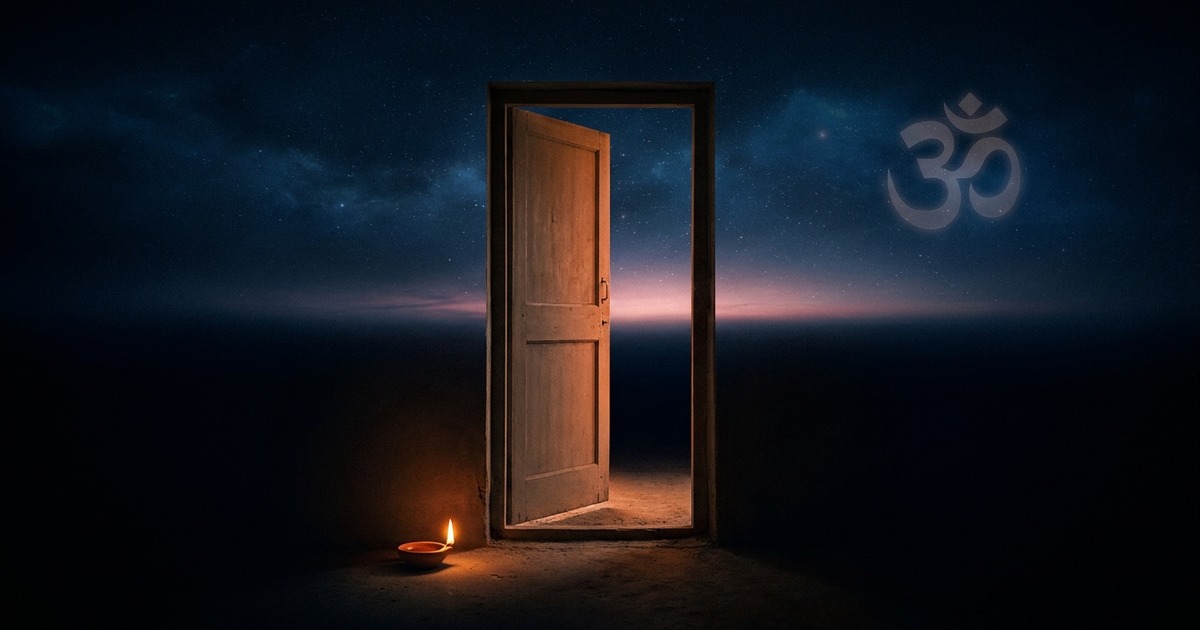
This is the Creator a parent recognizes. Watching. Sad sometimes. Glad sometimes. Always keeping the door open. Never enforcing what action did not already enforce.
Closing
The Christian doctrine of eternal hell and ritual confession is, structurally, a doctrine built by people who did not understand that action is the mechanism, not the deity. They needed an enforcer. They needed an institution. They needed a vocabulary of punishment to make moral behavior intelligible.
The Vedic tradition needed none of these. It named the mechanism — karma — and let the Creator return to His proper role: the watcher.
The Christian God of damnation, held to the moral standard of a flawed human parent, fails the test. The Vedic Sākṣī, held to the same standard, passes. He passes precisely because He does not threaten hell. He names karma and keeps the door open.
That is the God the parent recognizes. And that is the only God who is structurally coherent.
A parent who truly understands his child
does not threaten hell.
He names karma.
The Creator is the watching bird.
The eating bird is the doer.
The fruit ripens here.