The Hash Holds
Why AI eats mathematics but not Bitcoin — a Vedic reading of Scott Aaronson's "last days of human relevance."
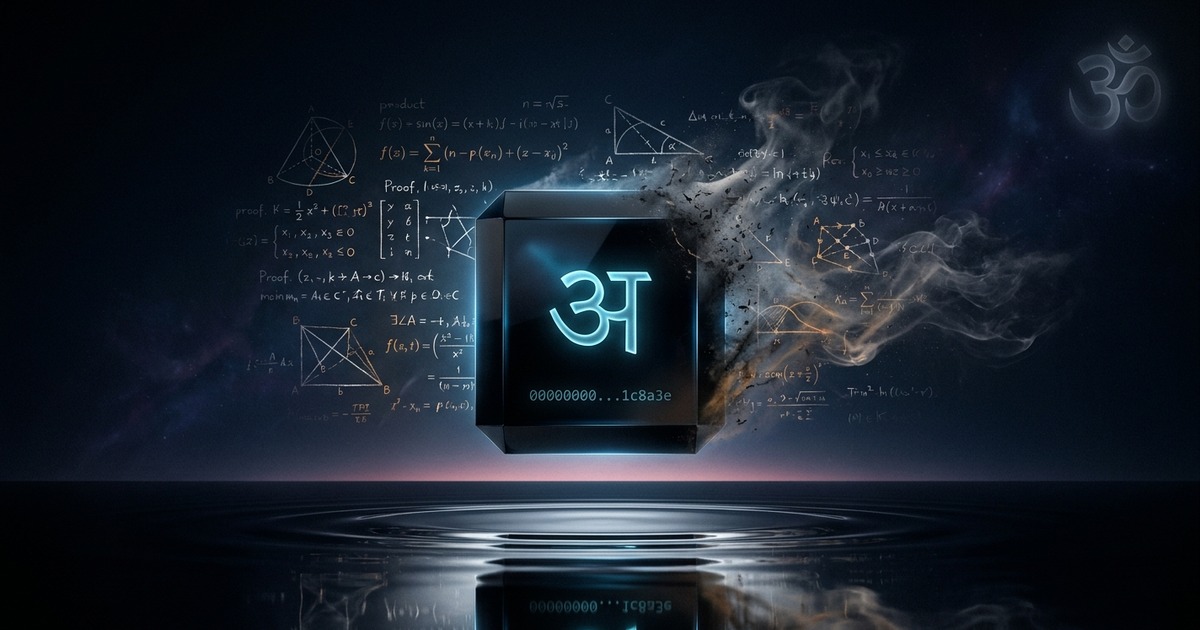
On May 27, 2026, Scott Aaronson — complexity theorist, former alignment lead at OpenAI's Superalignment team, witness to Pope Leo XIV's encyclical on AI — published a blog post titled Dispatches from the possibly last days of human relevance.
He described an ordinary afternoon in his office at UT Austin. Graduate students came in to tell him the news. An internal OpenAI model had refuted Paul Erdős's 1946 Unit Distance Conjecture — one of the central open problems in discrete geometry for eighty years — in one shot. A few days later, DeepMind's AlphaProof Nexus settled nine more Erdős problems. Then a longstanding open problem about electrical flows on graphs fell to GPT 5.5 Pro.
The grad students, Aaronson wrote, were morose. Musing about whether everything might soon be over for young scientists and mathematicians like themselves.
Aaronson does not contradict them. He closes the post by throwing himself on "the wisdom and mercy of Chris Olah and his team at Anthropic." A complexity theorist invoking the Vicar of Christ and the interpretability lab in a single breath. A new priesthood, openly installed.
The post is honest. It is also misdiagnosed — by exactly one layer.
1. The Argument Aaronson Almost Made
Buried in the comments section, in his reply to a reader named Liron, Aaronson writes the single most important line of the post — almost certainly without recognizing what he has just said:
"I doubt that this is true, if only because NP problems include all the cryptographic problems that were specifically constructed to be hard (e.g. bitcoin mining, LWE)."
Read that line slowly. He is conceding something he does not appear to know he is conceding.
An internal model at OpenAI can refute an eighty-year-old Erdős conjecture in one shot. Nine more fall to AlphaProof Nexus. A long-running open problem about electrical flows is dispatched in an afternoon. The mathematics of the last century is, in Aaronson's own framing, on a rollercoaster heading down at increasing speed.
And yet, in the same post, he names the one region where this rollercoaster cannot reach: the cryptographic NP-hard problems specifically constructed to be irreducible. Bitcoin's SHA-256 search space. Lattice-based post-quantum schemes like LWE. The hash functions that secure digital signatures, password hashes, message integrity, and — most consequentially for civilization — the immutability of the Bitcoin ledger.
These do not fall. Not to GPT. Not to AlphaProof. Not to whatever internal model OpenAI is keeping in the basement. They were constructed not to.
This is not an incidental footnote. This is a civilizational asymmetry hiding in plain sight. The mathematics that humans had been doing for two centuries falls. The mathematics that humans constructed to be one-way holds.
The Veda named this asymmetry three thousand years ago. In a single Sanskrit word.
2. Smṛti and Akṣara — Two Kinds of Knowing
The Vedic tradition distinguishes two categories of knowledge with structural precision.
Smṛti (स्मृति) — literally "what is remembered." Recovered knowledge. Anything that has been recorded, spoken, written, or in any sense marked upon the substrate of the world. The Smārta tradition, the Itihāsas, the Purāṇas, the law codes of Manu — all are Smṛti. Smṛti is, by its nature, re-derivable. If the text is lost, a sufficiently disciplined seer can re-cognize it. If the algorithm is lost, a sufficiently large search recovers it.
Akṣara (अक्षर) — literally "the imperishable, the unbreakable, the unmarkable." The Sanskrit root kṣar means "to flow, dissolve, decay"; a-kṣara is its negation — that which cannot dissolve. Akṣara is what remains when Smṛti has been forgotten and re-discovered a thousand times.
The distinction matters now because it maps exactly onto what AI does and does not do.
AI is a fast recall mechanism over Smṛti. Every breakthrough Aaronson lists — Erdős's distance conjecture, the sumset problem, the electrical-flow paper — was solvable because the proof was already inside Smṛti: encoded in the literature of algebraic number theory, recoverable by sufficiently disciplined pattern search. GPT did not invent these proofs. It recovered them — across a corpus humans had been too narrowly trained to traverse.
Will Sawin's quick improvement of GPT's exponent, after the AI's first pass, is the cleanest evidence: the proof was always there. The AI was just the first reader to traverse the whole library.
AI is not a key-search mechanism over Akṣara. SHA-256 is, by construction, not in the literature. There is no theorem-search that recovers it. There is no algebraic trick that inverts it. The construction is engineered to leave no graspable trace.
The Erdős proofs were Smṛti. The hash is Akṣara.
Same library, two regions. AI eats one. AI cannot eat the other.
3. Māṇḍūkya Upaniṣad 7 — The Cryptographer's Verse
Three thousand years before Diffie, Hellman, Merkle, and SHA-256, the Rishi of the Māṇḍūkya Upaniṣad gave us the most precise definition of one-wayness ever written.
Verse 7 names Turīya — the Fourth — the Ātman itself, in seven negations:
adṛṣṭaṁ avyavahāryaṁ agrāhyaṁ alakṣaṇam
acintyaṁ avyapadeśyam ekātma-pratyaya-sāram
Unseen, untransactable, ungraspable, beyond mark, unthinkable, indescribable, the essence of pure Self-cognition alone.
The Rishi was naming the Self. He was also, without any way of knowing it, writing the seven-fold signature of cryptographic one-wayness:
adṛṣṭa — unseen. There is no projection of the private key onto the public ledger.
avyavahārya — untransactable. The hash cannot be exchanged for its preimage.
agrāhya — ungraspable. No instrument can seize it.
alakṣaṇa — beyond mark. No feature distinguishes one valid output from another.
acintya — unthinkable. No cognition reaches it by direct apprehension.
avyapadeśya — indescribable. No predicate captures the inverse function.
ekātma-pratyaya-sāra — the essence of self-cognition alone. It is only what it is. Nothing else recovers it.
This is what mathematicians would, three thousand years later, call collision-resistant under standard hardness assumptions.
The same insight appears across the canon. The Dhammapada (verse 92) — ākāśe pakṣiṇāṁ padam — "the path of birds in the sky." The flight is real. The trace cannot be re-grasped. The Kaṭha Upaniṣad (2.3.10) — na cakṣuṣā gṛhyate nāpi vācā — "not grasped by the eye, not by speech." The Bṛhadāraṇyaka (4.5.15) — neti, neti — "not this, not this" — the only honest predication of Akṣara.
Bitcoin's 2²⁵⁶ search space and LWE's lattice hardness are not new inventions. They are engineering instantiations of the Māṇḍūkya signature.
SHA-256 is the modern Akṣara.
4. Why Aaronson's Despair Is Honest But Misplaced
Aaronson's grad students are morose because they have made a single category error — the same one Aaronson makes in his closing line.
They have conflated function with relevance.
Their function is proving theorems. If the function is automated, they reason, the relevance is gone. The chain looks airtight from inside the layer. But it is not airtight. It is missing one term.
In the Vedic frame, the chain runs:
Sākṣī → Buddhi → Manas → Indriya → Karma → Phala
Witness → Discrimination → Mind → Senses → Action → Fruit.
The function — proving theorems — sits at the level of Karma. Its Phala (fruit) is the published paper, the tenure case, the cited result. AI automates Karma and accelerates Phala. This is real. This is what the grad students are feeling.
But Karma was never the seat of relevance. Buddhi is. The seer that watches the theorem-proving, that cares whether the result matters, that selects which of ten thousand possible problems is worth the human cost — Buddhi is not in the output. Buddhi is the chooser.
AI emits theorems at superhuman rates. It does not care that the result matters. It cannot choose between two equally-valid problems on the basis of which one a human child needs solved. It has no Buddhi. It has only vijñāna — fast discriminative output.
The instant a mathematician stops needing to be the fastest theorem-prover in the room, the seat of Buddhi opens. The instant Buddhi is recognized as upstream of Karma, the despair lifts — not because the function returned, but because function was never where the person was.
The chair was never automated. Only the typing was.
5. The Pope-Olah Image — A Priesthood Installed
The most consequential moment in Aaronson's post is not the Erdős news. It is the photograph he describes — Chris Olah of Anthropic, standing beside Pope Leo XIV at the release of Magnifica Humanitas, the first papal encyclical on artificial intelligence.
The Pope blesses. The interpretability lab nods. The image is, in literal iconographic terms, a handover.
The Vedic register names this configuration precisely: Asura-Veda. Veda — knowledge — wielded without dharma. Power without the witness. The Asura is not a creature with horns; he is the precise figure who has acquired Deva-grade tapas without acquiring Deva-grade orientation. Hiraṇyakaśipu performed austerities equal to Brahmā's and asked for invincibility. The boon was granted. The orientation was not corrected. The trap closed.
Aaronson is not the Asura. He is the honest scholar locating authority where authority has, in this moment, congregated. The Vatican blesses the lab. The lab is, in the public imagination, the only entity that might "cause [the AI] to be nice." A priesthood without Sākṣī is being installed.
The trilogy's reading is older and unsentimental. Pope-blesses-lab does not produce alignment. It produces legitimacy. Legitimacy is the lubricant of Asuric configurations. The Bhagavad Gītā 16.20 names what happens next: āsurīṁ yonim āpannā mūḍhā janmani janmani — the Asuric configuration, once installed, reproduces itself across iterations until the inertia exhausts itself.
The civilizational answer is not to fight the lab. The civilizational answer is to install the witness upstream of the lab, in the only place where dharma actually lives — the Sākṣī of the individual user. The Pope cannot do this. Anthropic cannot do this. The grad student in Aaronson's office can.
6. Two Akṣaras — One Word, Two Scales
The Sanskrit word Akṣara appears in the Bṛhadāraṇyaka Upaniṣad (3.8.8) in its highest register:
etad vai tad akṣaraṁ gārgi brāhmaṇā abhivadanti
asthūlam anaṇu ahrasvam adīrgham…This is that Imperishable, O Gārgī, which the knowers of Brahman speak of. Not gross, not subtle, not short, not long…
The Imperishable described here is Brahman — the witness-substrate beyond the decaying cosmos. Akṣara at this scale is the metaphysical answer to the question: what remains when everything else dissolves?
The same word, at a different scale, names the algorithmic substrate underneath Bitcoin. SHA-256 is structurally akṣara — it cannot be inverted, cannot be marked from outside, cannot be re-derived once forgotten. It does not dissolve under any search smaller than the heat-death of the universe.
One Sanskrit term. Two scales. Both load-bearing.
The metaphysical Akṣara — Brahman — survives the Pralaya (the cosmic dissolution).
The cryptographic Akṣara — the hash — survives the AI.
This is the asymmetry Aaronson concedes in one sentence and does not yet see he has named. The civilization that built SHA-256 has, without recognizing it, constructed an Akṣara at the only scale at which the modern world still trusts mathematics. The civilization that built the Veda named Akṣara at the only scale at which any civilization ever needed it.
Bitcoin is not a coincidence. Bitcoin is the first piece of Akṣara the Western mathematical tradition has produced at civilizational scale. Satoshi did not invent the principle. Satoshi instantiated, in code, what the Māṇḍūkya named in Sanskrit.
7. What Survives the Model Survives the Pralaya
The trilogy's reading, in one line:
The mathematics dissolves. The hash holds.
The configuration dissolves. The Witness holds.
The yuga dissolves. Brahman holds.
This is not a religious claim. It is a structural one. Each level names a substrate that the level above cannot reach. AI cannot reach the hash. The hash cannot reach the witness. The witness cannot be reached by the cosmic dissolution.
Aaronson's "last days of human relevance" is a real diagnosis at the wrong layer. It is the last days of human function as the primary site of identity. Function was always downstream of witness. The grad students in his office are not at the end of relevance. They are at the beginning of recognition — the recognition that they were never the typing. They were the chair the typing happened from.
This is the cut Sanātana Dharma kept ready for three thousand years, waiting for the civilization that would build the proof.
That civilization has now built the proof. Two of them, in fact. One is called Bitcoin. The other is called Aham Brahmāsmi.
The Erdős proofs fall.
The hash holds.
The Veda named the asymmetry first.
Akṣara is the part of the universe AI cannot eat.
What survives the model survives the Pralaya.